What does slow hiring cost an IT services firm?
Between a signed contract and the first billed hour sits revenue that has been won but can’t be invoiced. It seldom appears on any dashboard, because it falls between sales and delivery. Sizing it takes three numbers every services firm already has, and most of the time a hiring team can win back sits at the front of the funnel.
Two clocks, one owner
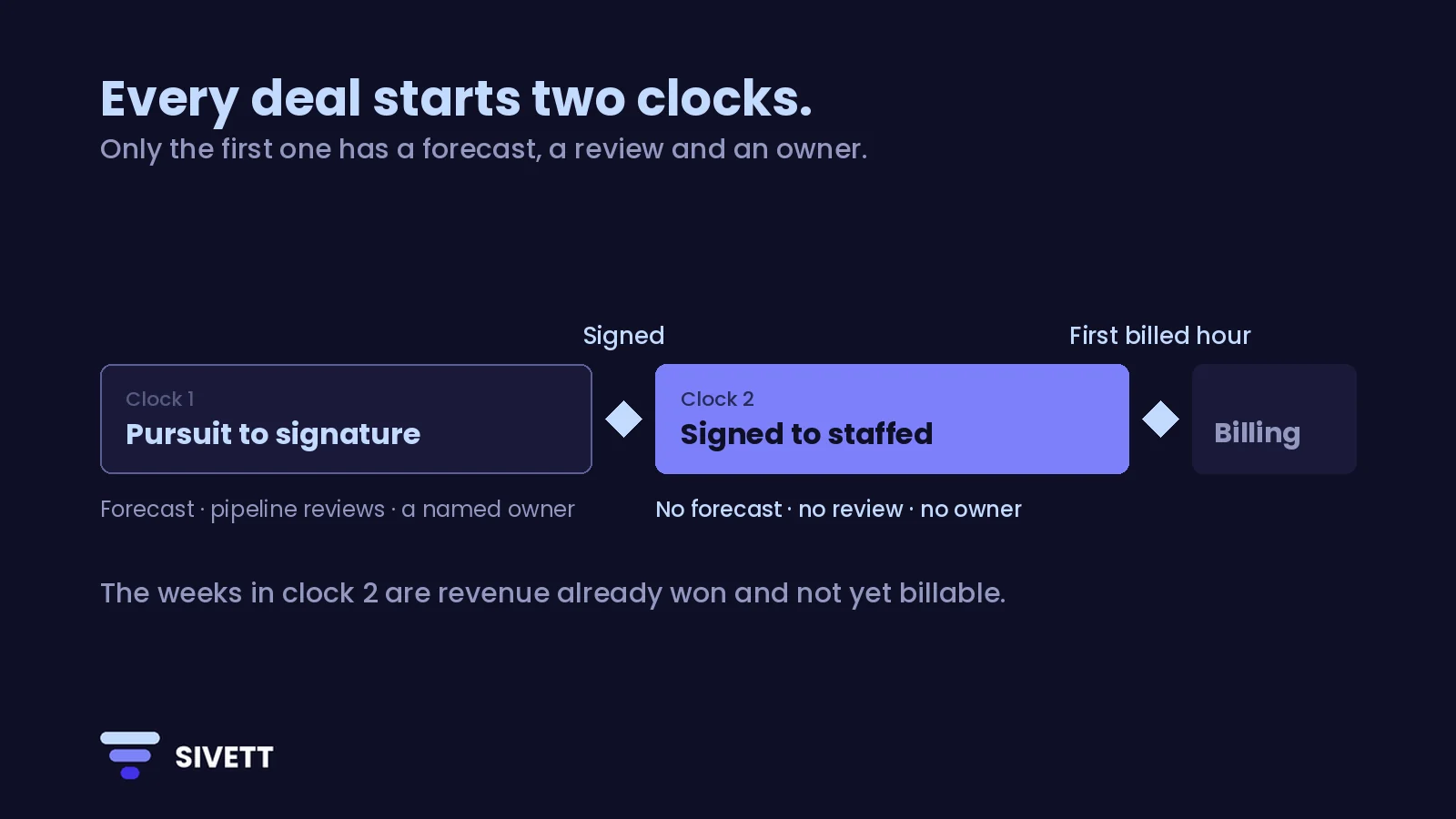
Every deal starts two clocks. The first runs from pursuit to signature, and it’s managed closely: forecasts, pipeline reviews, a named owner. The second runs from signature to the first billed hour. It’s usually filed under “ramp”, and it rarely gets the same scrutiny.
Yet the second clock is where signed revenue waits. Every seat still open after signature is one the client has agreed to pay for and can’t yet be billed.
How to size the gap
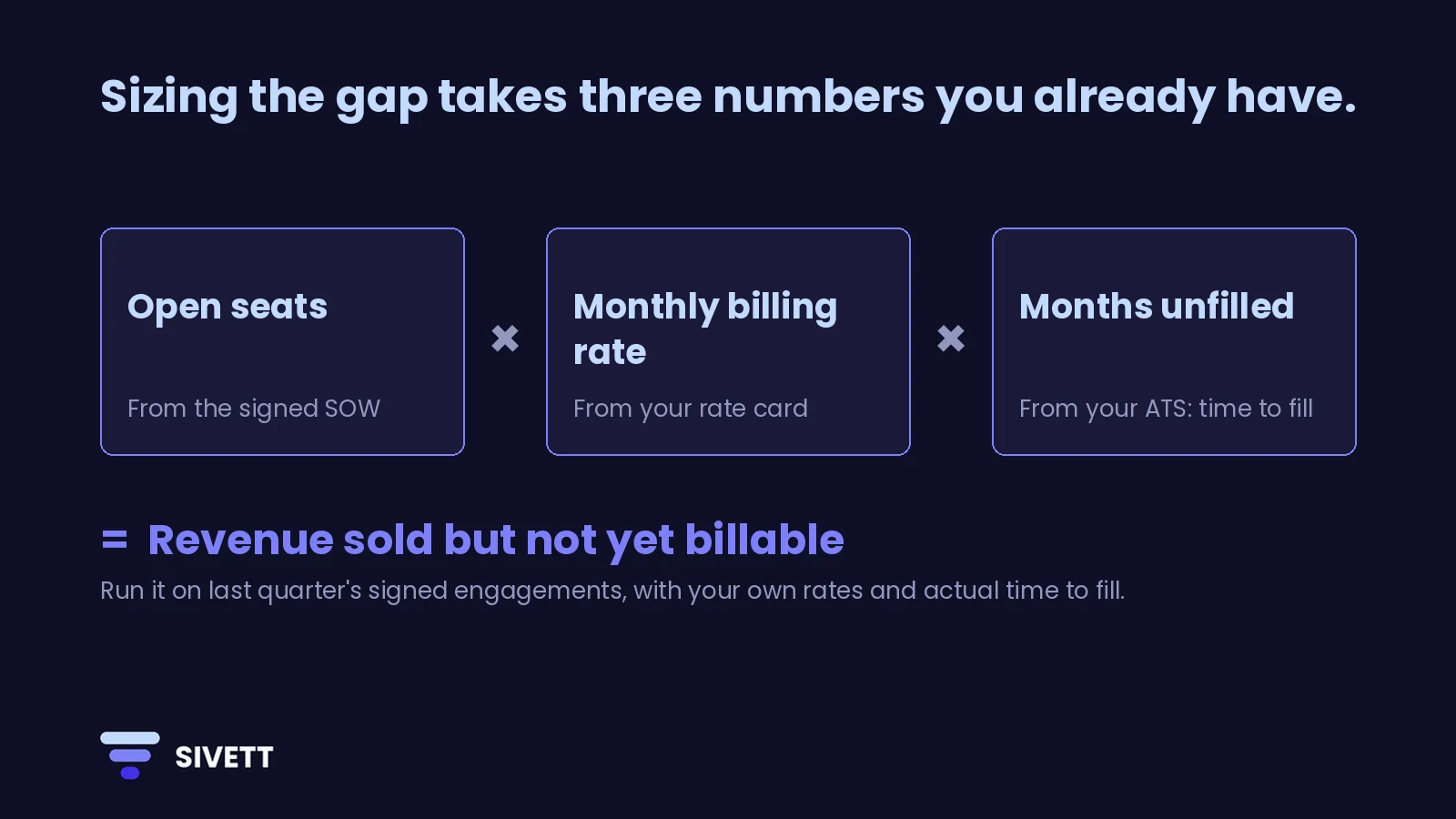
Run the calculation on the engagements signed last quarter, using your own rate card and your actual time to fill. The result is revenue your business has sold and is still waiting to collect.
The direct figure understates the cost. Three indirect costs follow a slow start:
- The client’s first impression of delivery. The engagement starts late or under-staffed, at exactly the point the client is judging whether the deal was a good one.
- Stopgap staffing. Bench resources get placed to fill the gap even when the fit is weak, which moves the problem instead of solving it.
- Rushed hiring later. Once a seat has been open long enough, the pressure shifts from finding the right person to finding anyone.
Why the gap rarely has an owner
| Function | Sees the cost | Controls hiring speed | Carries the revenue number |
|---|---|---|---|
| Sales | At signature, then moves on | No | Up to signature |
| Delivery | Yes, as lower utilisation | No | Once billing starts |
| Talent acquisition | Rarely | Yes | No |
No function both sees the cost and controls the speed. That isn’t anyone’s failure; it’s how the structure divides the work.
Making it someone’s number
Four changes make the gap visible without reorganising anyone:
- Tag positions tied to signed engagements, so signed demand can be tracked apart from pipeline demand.
- Track time to fill on those positions separately. It’s the figure that converts directly into revenue.
- Report “revenue waiting on hiring” monthly as its own line, using the calculation above.
- Review it alongside the sales pipeline, so the second clock gets the same attention as the first.
Who owns it matters less than whether anyone can see it. Measure it where the lever sits, in TA and delivery together, and report it where the money shows, in finance.
Where the time goes
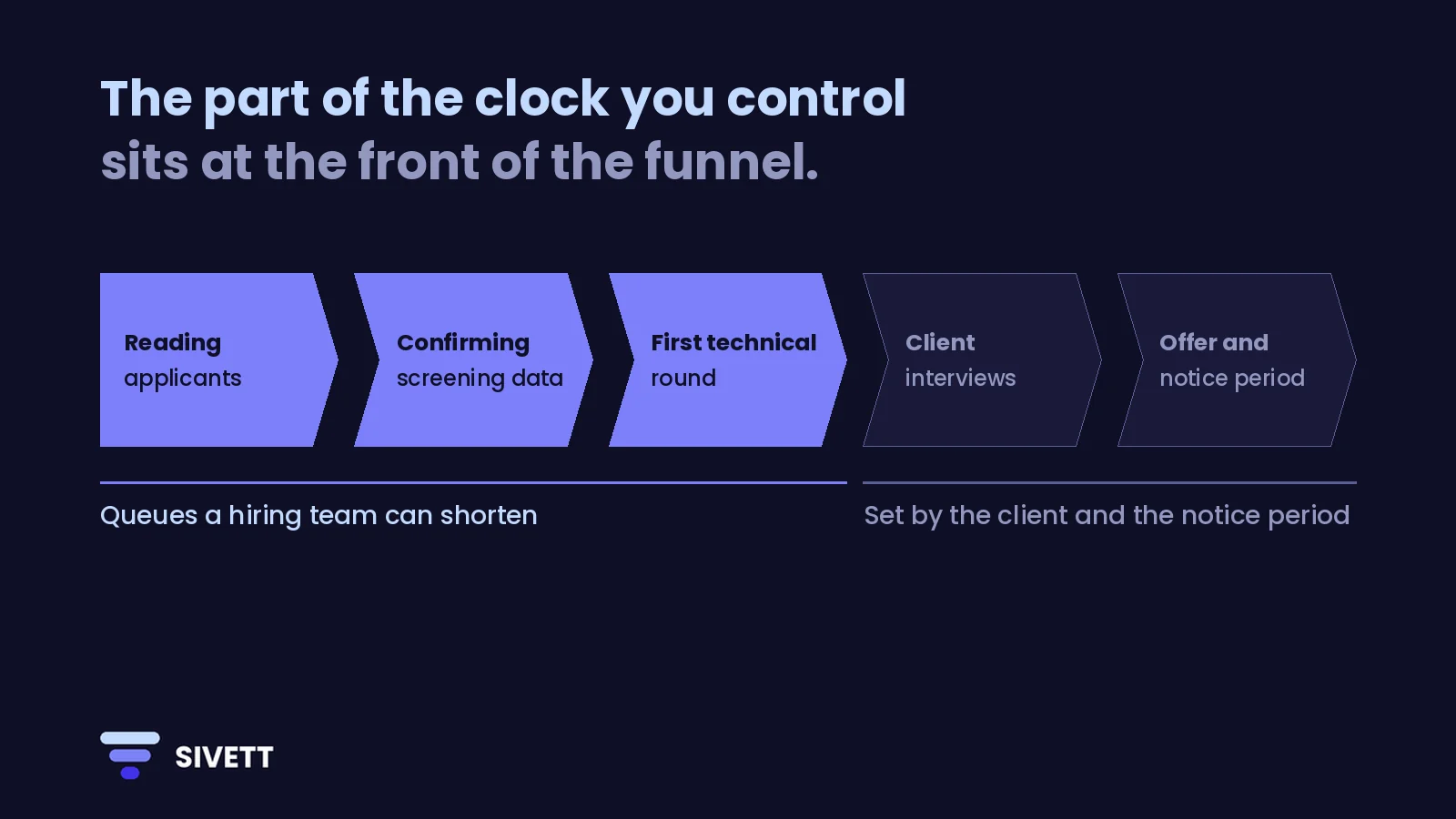
Not all of time to fill can be shortened. Client interviews run on the client’s calendar, and a 60- or 90-day notice period is fixed before anyone speaks to the candidate. The stages a hiring team controls sit at the front: reading applicants, confirming screening data, and the first technical round. Each is a queue rather than a decision, which is why each can be shortened. (How many resumes can a recruiter properly review? covers why reading applicants becomes a queue.)
Key takeaways
- The time between signature and the first billed hour is revenue won but not yet billable.
- Size it with three numbers: open seats × monthly billing rate × months unfilled.
- It rarely has an owner, because no single function both sees the cost and controls hiring speed.
- Tag positions on signed engagements, track their time to fill, and report the revenue waiting every month.
- The time a hiring team can win back sits at the front of the funnel.
Where Sivett fits
As an AI recruitment platform for IT services firms, Sivett takes the queues out of the front of that clock, and shows you when a role is at risk before the date slips.
- Shortlists in days, not weeks. Profiles are scored as they arrive, screening goes out the moment someone makes the shortlist, and the first-round interview needs no panel slot. Candidates take it when it suits them.
- Your engineers stay billable. The first technical round, including a coding round when the role needs one, runs without an engineer on the call. Engineers meet only candidates who have already shown they can do the work.
- Hiring managers see fit competency by competency. Sivett reads each JD for the competencies it calls for and the level each one needs, then assesses every interview against both the competencies and the JD. The hiring manager sees where a candidate meets the bar and where they fall short, and the next panel gets questions aimed at the gaps.
- See a role running dry before the client does. For every role you see live candidates per open seat, and how many have cleared the first round. When those numbers fall, you source more while there’s still time.
- Your ATS stays the system of record. Everything Sivett learns about a candidate goes back to their record in your ATS, so recruiters keep working where they already do. See ATS integrations.
At Algoleap Technologies, 523 applicants became 47 completed first-round interviews and a shortlist in three days, without recruiter time spent on first-round screening.
Read more about candidate matching, candidate screening and AI interviews.
Next in this series: How many resumes can a recruiter properly review per role?