How many resumes can a recruiter properly review per role?
A recruiter can give about forty resumes a proper read in a week. A single IT services position can draw more than 500. The gap between those two numbers now decides who gets hired more than any judgement about fit, and it can be closed without shrinking the applicant pool or growing the team.
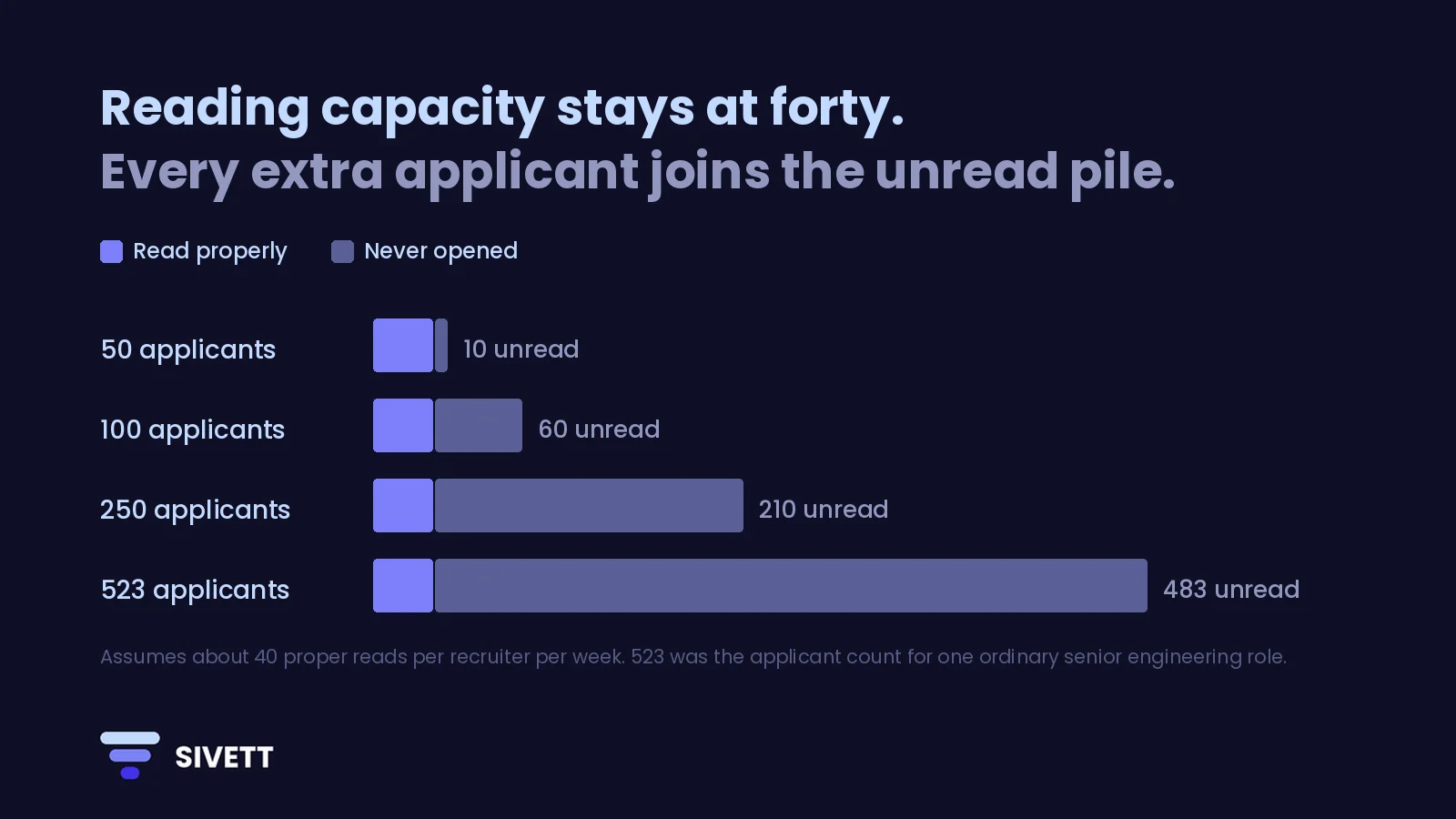
The arithmetic of a recruiter’s week
A proper read isn’t a keyword scan. It means checking the work behind the job titles, how deep the relevant skills go, where the candidate has worked and how their career has moved. Done well, that takes real time for every resume.
That time competes with the rest of the job: screening calls, interview scheduling, follow-ups, hiring-manager updates and, in IT services, three or four open positions at once. In our experience it leaves room for about forty proper reads a week.
Against a large pool, that number produces a striking result.
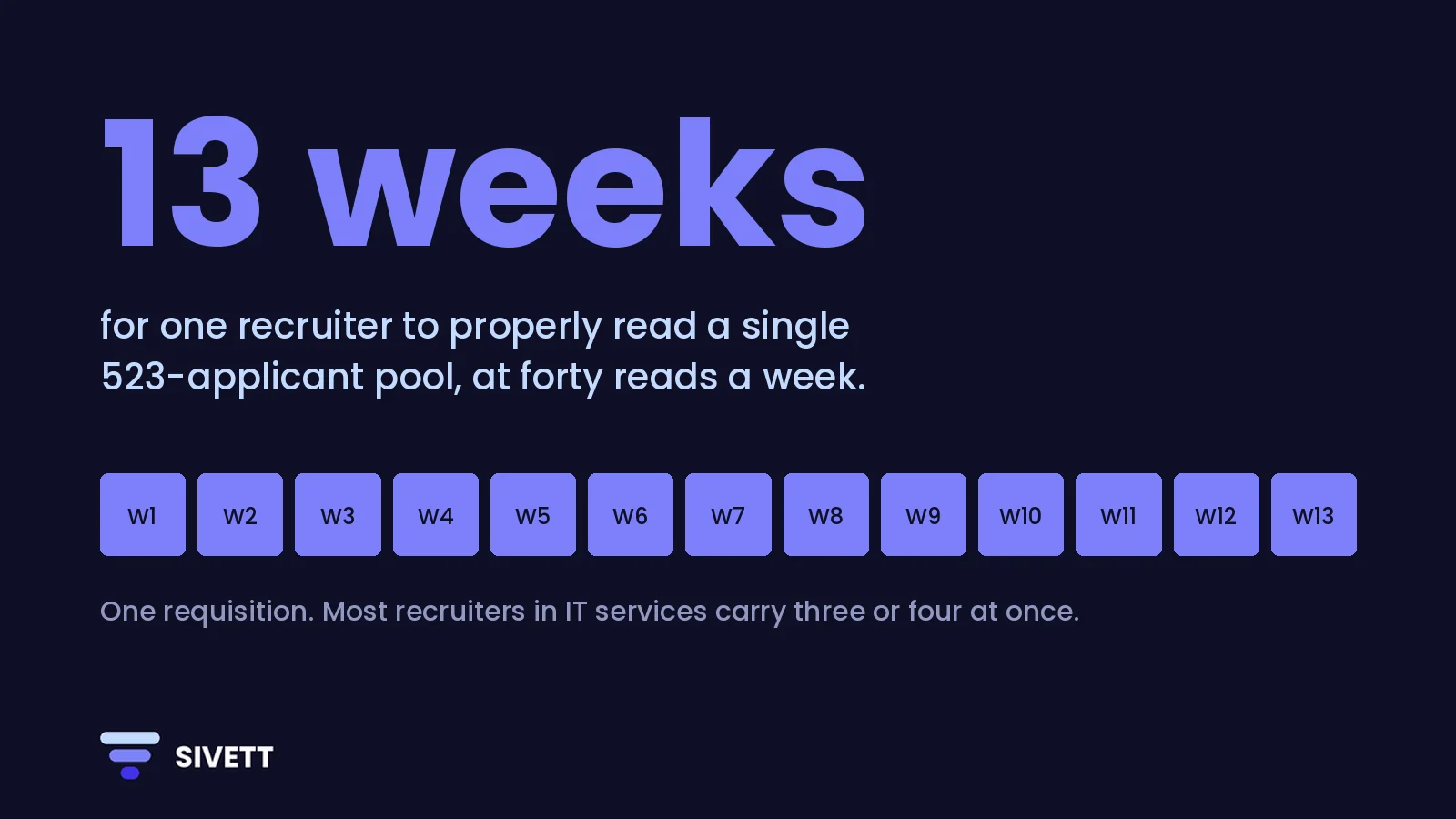
At forty a week, reading all 523 applicants for one ordinary senior engineering role would take a single recruiter thirteen weeks. No role waits that long, so most of the pool is never opened. Those candidates aren’t rejected on merit. They’re never assessed at all.
Who gets read when nobody decides
When applications outnumber reading capacity, three things quietly choose the forty.
| What decides | Who it favours | Who it misses |
|---|---|---|
| Arrival order | The earliest applicants | Strong candidates who applied on day four |
| Keyword match | Resumes that echo the job description’s wording | Experienced people who describe the same work differently |
| Reachability | Whoever answers the first call | Candidates busy in their current job |
None of these measures fit. The shortlist ends up reflecting the order and wording of applications as much as the quality of the candidates, and nobody chose that trade-off.
Is a bigger applicant pool still an advantage?
The case for volume is real: more applicants raise the odds that the right person is somewhere in the pool. It only pays off if that person can be found. Once applications pass reading capacity, each extra applicant adds to the unread part of the pool, not the read part.
In our experience that point arrives at around a hundred applicants per role for most teams, and many IT services roles are well past it. The pool hasn’t become less valuable. It has outgrown the process built to read it.
Three ways to close the gap
| Approach | What it costs | What you give up |
|---|---|---|
| Reduce volume: tighter posts, fewer channels | Little | The depth of pool that makes volume worth having |
| Add recruiters | One salary for roughly forty more reads a week | Flexibility, since services demand rarely holds steady enough to staff for the peak |
| Automate the first read | A tool and the effort to set it up | Nothing in the pool; recruiters keep the judgement calls |
Only the third keeps both the pool and the team as they are. It works only if the automated first read is as good as a recruiter’s, which means it has to read for more than keywords.
What a proper first read checks
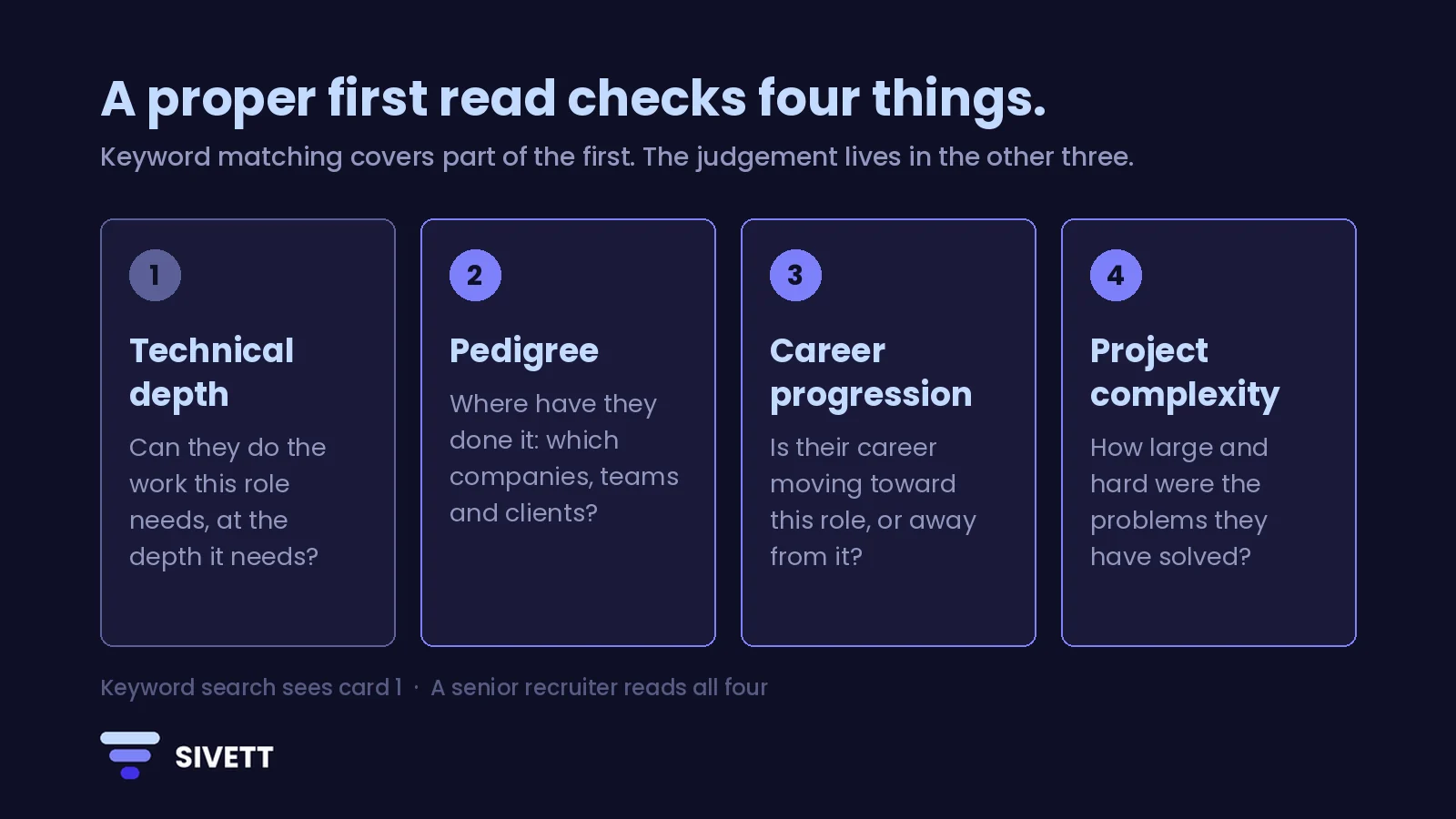
Keyword matching answers part of one question: does the resume mention the right skills? An experienced recruiter reads for four things.
- Technical depth. Can they do the work this role needs, at the depth it needs?
- Pedigree. Where have they done it: which companies, teams and clients?
- Career progression. Is their career moving toward this role, or away from it?
- Project complexity. How large and hard were the problems they’ve solved?
The weight on each should move with the role. A greenfield build leans on project complexity; a client-facing lead leans on progression and pedigree. Applied consistently, these four turn a pile of 500 resumes into a ranked list a recruiter can defend.
Key takeaways
- A recruiter can give about forty resumes a proper read in a week, and one position can draw more than 500.
- At that rate, a 523-applicant pool would take thirteen weeks to read. In practice most of it is never opened.
- By default, arrival order, keyword match and reachability decide who gets read, not fit.
- Past about a hundred applicants per role, extra volume adds unread resumes, not better hires.
- Automating the first read keeps both the pool and the team, provided it reads for depth, pedigree, progression and complexity.
Where Sivett fits
Sivett is an AI recruitment platform for IT services firms. It gives every profile a first read, so the forty you read yourself are the right forty.
- A shortlist you can defend to the hiring manager. Every resume is read on the four things above. Each score comes with its reasoning, so when someone asks why a profile made the list, the answer is already written down.
- Read for the role, not against a keyword list. Engineering, sales, product and presales roles are each read on what matters for that kind of role, and you shift the weighting when a role is unusual.
- The same profile gets the same answer. Two recruiters scoring the same resume against the same role get the same result, on Monday or on Thursday.
- Day-four applicants get the same read as day-one. Arrival order stops deciding who gets seen. Blind scoring is there when you want the work judged before the name.
Profiles that clear the bar move on to screening on WhatsApp or email, then a first-round interview assessed against the competencies the role needs, at the level it needs them. Nobody works a call list. At Algoleap Technologies, 523 applicants became 47 completed first-round interviews and a shortlist in three days, without recruiter time spent on first-round screening.
Read more about candidate matching, candidate screening and AI interviews.
Next in this series: How do you find the right candidate already in your ATS?