How much billable engineering time do first-round interviews cost?
At about an hour each, the first-round technical interviews for a single high-volume position can take one to two weeks of an engineer’s billable time. The cost rarely shows up as a hiring cost; it shows up as utilisation slipping. The first round doesn’t need an engineer’s time. It needs an engineer’s standard, written down before the first interview.
The arithmetic of one position
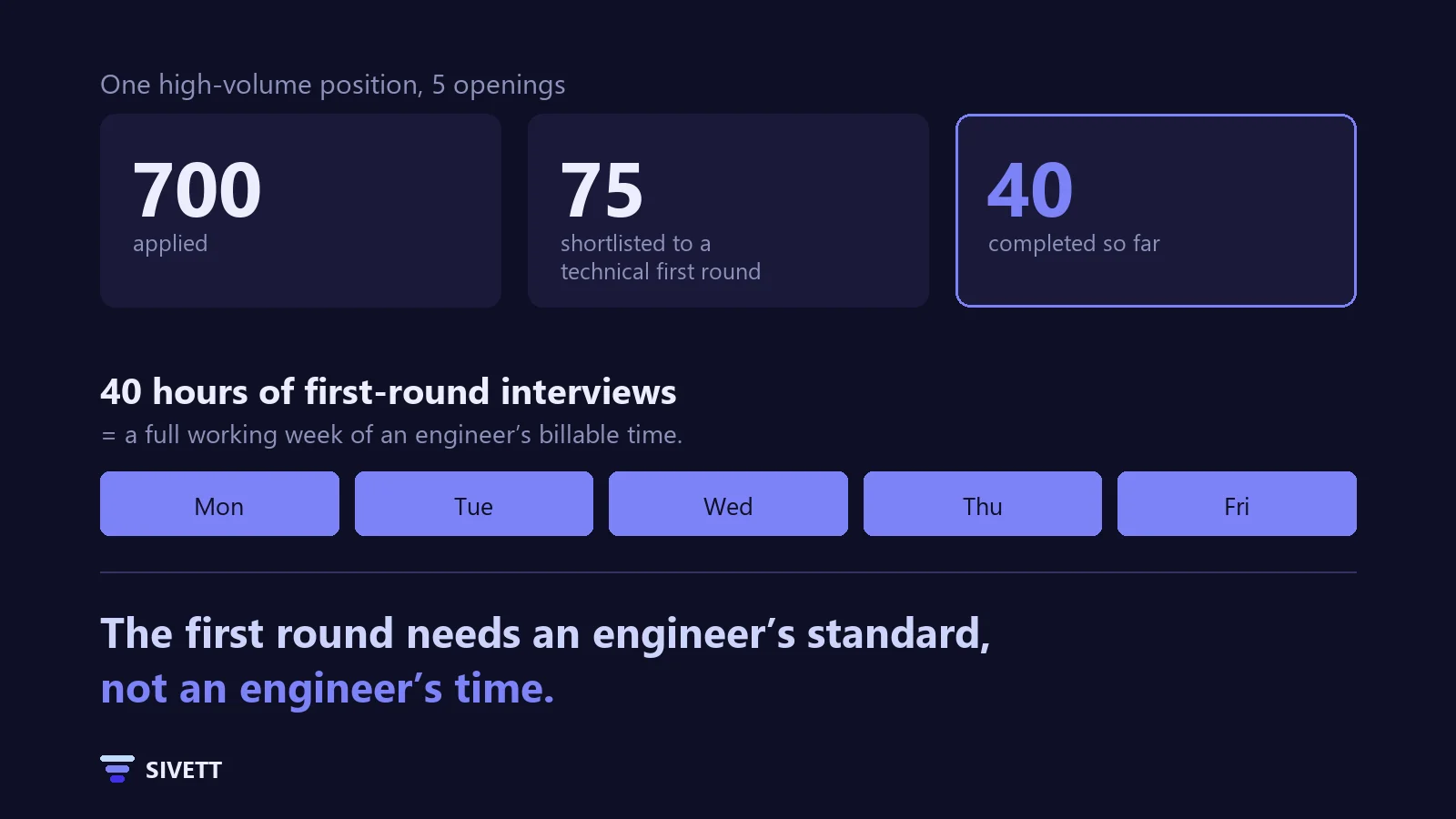
Take one high-volume position with five openings. 700 people applied, 75 were shortlisted to a first-round technical interview, and 40 of those interviews have been completed so far.
| Candidates | Engineer hours at one hour each | |
|---|---|---|
| Applied | 700 | — |
| Shortlisted to a technical first round | 75 | 75 |
| Interviewed so far | 40 | 40: a full working week |
| Still scheduled | 35 | 35: most of a second week |
At an hour each, those 40 interviews are a full working week of an engineer’s billable time, and the 35 still scheduled make it closer to two. That is one position. Delivery teams in services run several like it every quarter.
The hour on the calendar also understates it. Each interview carries preparation, a write-up and the context switch back into client work, and each one needs a slot that suits both the engineer and the candidate.
Why the first round lands on engineers
A recruiter can verify a resume and confirm screening data. Judging whether someone is strong in a particular competency is a different call: whether a backend engineer really understands API design, or whether a mobile developer can reason about list performance. So the first round goes to whoever can make that call, and that person is usually billable.
Nobody decided this should be the arrangement. It follows from a reasonable rule, that competency needs to be judged by someone competent, applied at a volume the rule was never designed for.
An odd arrangement at volume
At volume, the scarcest and most expensive people in the business end up doing the earliest, highest-volume filtering. Most of the candidates they meet in a first round won’t go further, which is exactly what a first round is for.
| Where the cost could show up | Does it? |
|---|---|
| The hiring budget | Rarely. Engineer hours aren’t charged to hiring. |
| Delivery utilisation | Yes, as billable hours that quietly slip. |
| Time to fill | Yes, as days spent waiting for panel slots. |
| The candidate’s experience | Yes, when interviews are rescheduled around client work. |
So the cost rarely shows up as a hiring cost. It shows up as utilisation slipping, and as time to fill stretching while a role waits for someone to be free. For how that delay turns into revenue that can’t be billed, see what slow hiring costs an IT services firm.
What the first round actually needs
The first round doesn’t need an engineer’s time. It needs an engineer’s standard: the competencies the role actually calls for, and the level each one needs, written down before the first interview.
- The competencies. What the role will really ask of someone, drawn from the job description rather than a generic question bank.
- The level for each. Expert API design and only foundational front-end, say, for a backend-heavy full-stack role, instead of one difficulty for the whole interview.
- What a good answer shows. First-hand detail, sound reasoning and depth, so two assessments of the same answer land in the same place.
- A coding exercise when the role needs one, and not when it doesn’t.
Once the standard is written down, applying it no longer depends on who happens to be free that week. The same bar is applied to the fortieth candidate as to the first, and engineers spend their interviewing time where their judgement matters most: on the candidates who have already met it.
Three ways to run the first round
| Approach | What it costs | What you give up |
|---|---|---|
| Engineers interview every shortlisted candidate | Billable hours: a week or more per high-volume position | Utilisation, and days waiting for panel slots |
| Recruiters run the first round as a phone screen | Little | A real judgement of competency depth |
| A structured first round against a written standard | Writing the standard once per role | Nothing: engineers keep the later rounds |
Only the third keeps both the standard and the engineers’ time. It works only if the standard is specific to the role, which is why writing it down comes first.
Key takeaways
- One high-volume position can take one to two weeks of an engineer’s billable time in first-round interviews alone.
- The first round goes to engineers because judging competency needs someone competent, not because anyone chose the arrangement.
- The cost rarely shows up as a hiring cost; it shows up as utilisation slipping and time to fill stretching.
- The first round needs an engineer’s standard: the competencies the role calls for, and the level each one needs, written down first.
- With the standard written down, engineers can spend their interviewing time on candidates who have already met it.
Where Sivett fits
Sivett, an AI recruitment platform for IT services firms, runs the first-round technical interview against the standard the role calls for, so engineers meet only the candidates who clear it.
- The standard comes from the JD. Sivett reads each job description for the competencies it calls for and the level each one needs, and assesses every interview against both.
- No panel slot to find. Candidates who clear screening get a link and take a proctored interview whenever suits them, with a coding round when the role needs one.
- Asked against achieved. Every answer is read against the level its question asked for, with the deciding quote, what the answer left out, and the full transcript and recording.
- A head start for the next panel. Every report includes probes for the next round, drafted from the gaps the first round found.
The AI interview replaces the first-round screening call, not your technical panel: engineers still run the later rounds, and a recruiter decides who goes through. At Algoleap Technologies, 523 applicants became 47 completed first-round interviews and a shortlist in three days, without recruiter time spent on first-round screening.
Read more about AI interviews and candidate matching.
Start the series from the beginning: What does slow hiring cost an IT services firm?