Candidate matching by fit, not keywords
Keyword search finds resumes that use your words. Sivett reads every resume against the job description and scores it out of 100 across four dimensions chosen for the kind of role, weighted the way you set them, with the reasoning written out for each. Everyone at or above your threshold is shortlisted automatically.
One resume, four dimensions, weighted for the role, reasoning on each
Why keyword search misses people
Keyword search matches the tools a candidate names. Fit usually lives in the work they did, and the same work gets described in different words. Two engineers with eight years each of building CI/CD pipelines might write “Jenkins” and “GitLab CI”. A search for one never surfaces the other.
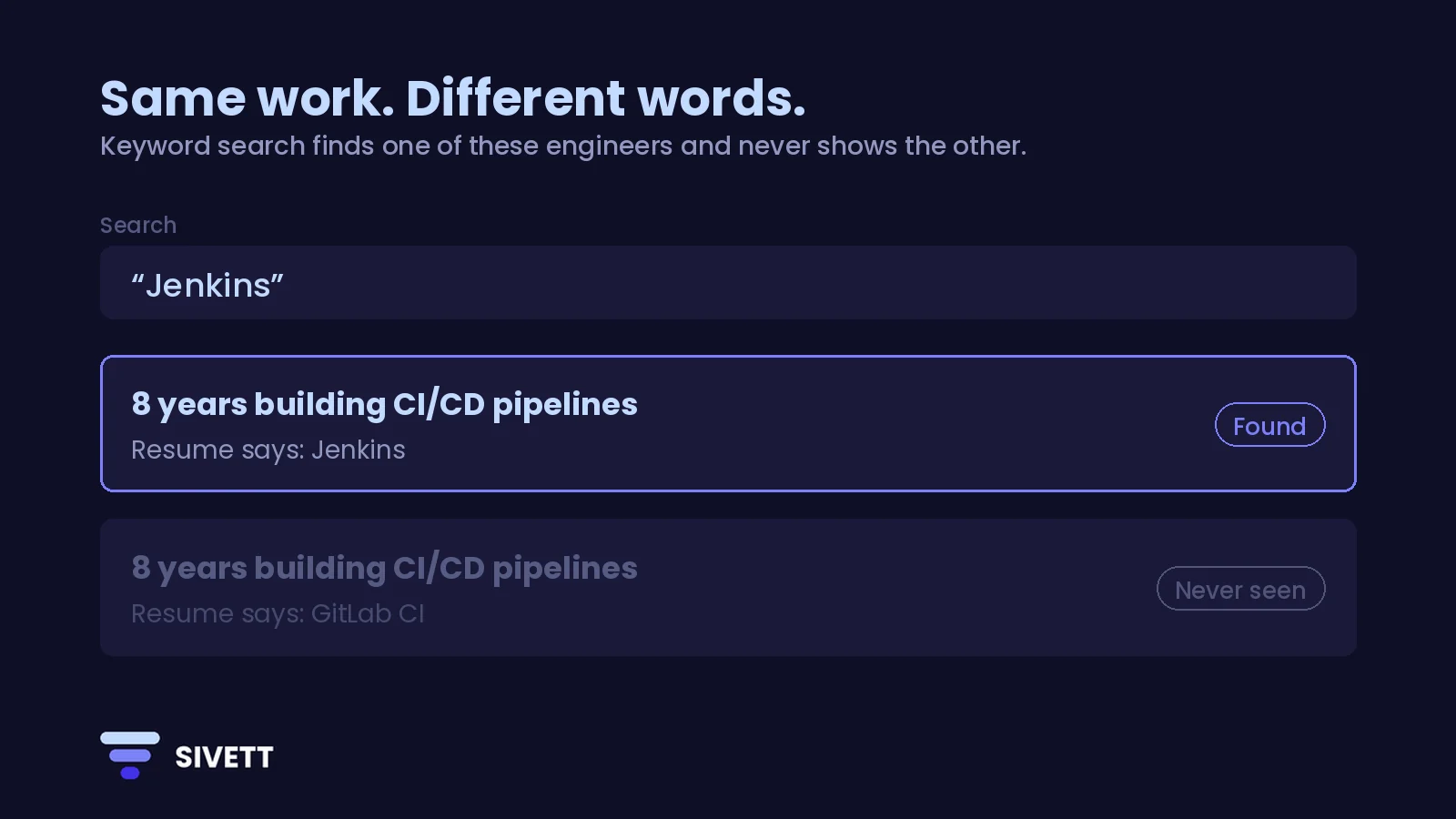
The gap widens with seniority, because experienced people describe what they achieved rather than list what they used. Sivett scores the work, so the vocabulary on a resume doesn’t decide who gets considered. Why reading capacity, not applicant volume, decides who gets hired.
Four dimensions, chosen for the role
A single match percentage hides why someone ranked where they did. Sivett scores every resume on four separate dimensions, and which four depends on the kind of role. It works out the role family from the job description, so an engineering role and a sales role are never scored on the same things.
| Role family | The four dimensions it is scored on |
|---|---|
| Engineering | Technical Skills · Pedigree · Career Trajectory · Project Complexity |
| Sales | Revenue Complexity · Deal Complexity · Domain Fit · Career Trajectory |
| Product | Product Thinking · Project Complexity · Cross-Functional · Pedigree |
| Presales | Technical Breadth · Deal Complexity · Domain Fit · Career Trajectory |
| Other | Skills · Pedigree · Career Trajectory · Project Complexity |
For an engineering role, that means asking four different questions of every resume: can they do the work at the depth it needs, where have they done it, is their career moving toward this role, and how large and hard were the problems they solved.
Weighted the way the role needs
The final score is not an average. Each dimension is multiplied by its weight, and the four weights add up to 100%. The defaults suit most roles; change them when a role is genuinely unusual, such as a greenfield build where project complexity matters more than pedigree.
Small changes rarely move the shortlist; large ones will. Scores don’t shift silently when you change the criteria: Sivett shows that the criteria changed and lets you re-score everyone in one run.
Hard gates before scoring
Two settings on the position act as gates rather than preferences. A resume outside the experience range, or one showing none of the required skills, is set aside before it is scored, with the reason written on the record. Nothing is dropped without an explanation, and widening the range brings people back with one re-score.
A shortlist that moves on its own
You set a shortlist threshold for each position, anywhere from 50 to 95 out of 100 (70 by default). Everyone at or above it is shortlisted automatically, and shortlisting is what sends the screening questions. Everyone below it stays visible with their score and reasoning, so a recruiter can pull a near miss forward.
What recruiters see
- A ranked list. Every candidate on the position with a score out of 100 and the stage they are at.
- The reasoning behind each dimension. What the resume actually evidenced, ready to share when a hiring manager asks why.
- Missing required skills flagged. Shown on the record as a flag, not a silent rejection.
- The same answer every time. The same resume against the same criteria always gets the same score, on Monday or on Thursday.
- Blind scoring when you want it. Names and contact details are hidden while candidates are compared; revealing one is deliberate and logged.
Finding people already in your ATS
Sivett searches your entire ATS repository by meaning, not keywords, so the right past applicant surfaces for every new position, including people who never applied to it. They’re scored on the same dimensions as fresh applicants. How to find the right candidate already in your ATS.
Results
“My team used to spend the week chasing candidates. They spend it choosing now.”
Head of Talent, Algoleap Technologies
Algoleap Technologies is an AI-native and product engineering services firm with 30+ recruiters. No recruiter time was spent on first-round screening. Every position Algoleap’s recruiters open runs through Sivett.
Candidate matching: questions.
Does this replace our ATS search?
No. Your ATS stays the system of record. Sivett searches your entire ATS repository by meaning, not keywords, so the right past applicant surfaces for every new position, including people who never applied to it. They’re scored on the same dimensions as fresh applicants.
How is each score explained?
Every score is broken into its four dimensions, each with written reasoning about what the resume actually evidenced. When a hiring manager asks why someone scored as they did, the answer is already on the record.
Can we change the weighting for a role?
Yes. Each position starts from sensible default weights for its role family, and you can change them, as long as the four add up to 100%. Existing candidates keep their scores until you re-score them.
How do you keep scoring fair?
Every resume on a position is read against the same criteria and weights, and the same resume against the same criteria always gets the same score. Blind scoring hides names and contact details until someone deliberately reveals them, and every reveal is logged.
Which roles does it work for?
Engineering, sales, product and presales roles each have their own four dimensions. Anything else is scored on skills, pedigree, career trajectory and project complexity.
Month one is on us.
Setup, JD tuning, and your first positions running live. We’d rather not bill you while we’re still configuring.
12-month term · 90-day exit · every recruiter included